








Greek equities have remained among the world’s best-performing markets this year, rising 26.3 per cent in the first 10 months of 2026 despite a retreat in October.
In a report published on November 2, Deutsche Bank highlighted the Athens market’s outperformance against a backdrop of an energy crisis, uncertainty over the outlook for artificial intelligence and volatility in European bond markets.
The Athens Stock Exchange has delivered more than twice the returns of the pan-European STOXX 600 and Wall Street’s S&P 500, comfortably outpacing its German, Italian and Spanish counterparts.
Athens retains strong gains despite October sell-off
Greek stocks fell 4.4 per cent in October, according to Deutsche Bank, but remained up 26.3 per cent for the year to the end of the month.
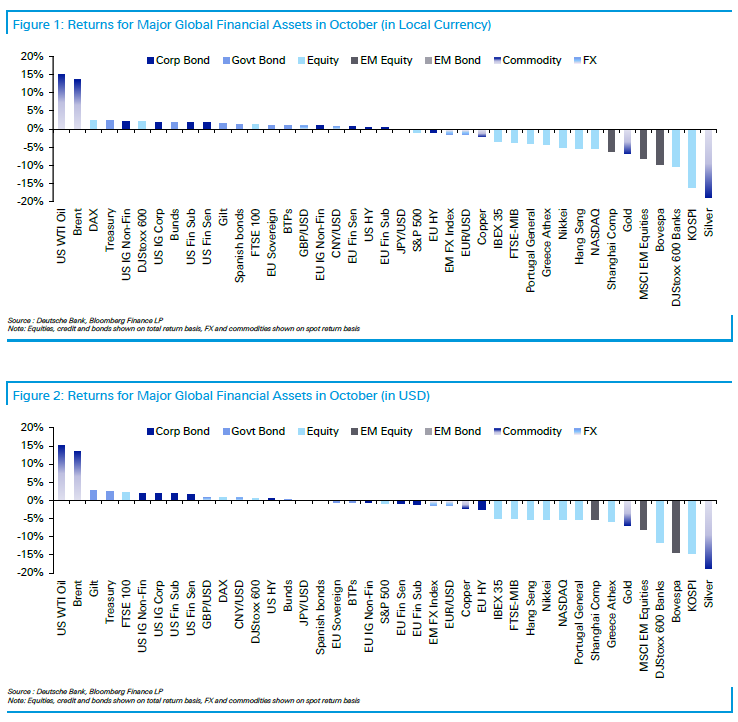
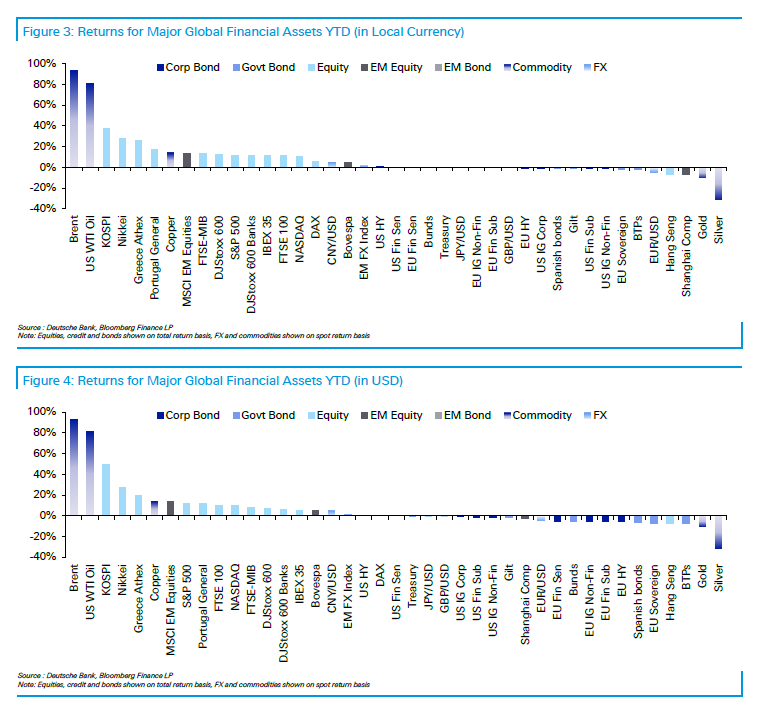
The contrast with larger international markets is striking. The STOXX 600 has gained 12.4 per cent since the start of the year, compared with an 11.7 per cent rise for the S&P 500 and 10 per cent for the Nasdaq. In Europe, Germany’s DAX is up 5.4 per cent, Italy’s FTSE MIB has gained 13.6 per cent and Spain’s IBEX 35 has risen 11 per cent.
Even the STOXX 600 Banks index, despite a sharp October sell-off, remains 11.2 per cent higher for the year.
Among the major markets tracked by Deutsche Bank, only Japan’s Nikkei has marginally outperformed Athens, with a gain of 27.7 per cent.
European bank stocks suffer 11.4% slump
October proved particularly bruising for European bank shares, with the sector recording its steepest monthly decline since 2023.
France was at the centre of the turmoil, as political uncertainty and concerns over the country’s public finances pushed the yield spread between French and German 10-year government bonds to 174 basis points.
The yield on France’s benchmark 10-year bond climbed to 5.07 per cent, its highest level since 2002, unsettling European sovereign debt markets.
AI concerns trigger technology sell-off
Growing doubts over the scale of investment in artificial intelligence prompted heavy selling in technology stocks.
The Nasdaq fell 5.3 per cent in October, while the Philadelphia Semiconductor Index plunged 15.3 per cent. In Asia, South Korea’s KOSPI lost 16.2 per cent.
By contrast, the equal-weighted S&P 500 rose 5 per cent, suggesting investors were shifting towards companies outside the handful of technology giants that have dominated US equity markets.
Oil hits $117 as investors turn to bonds
Geopolitical tensions in the Middle East pushed Brent crude to $117.64 a barrel, a rise of 13.6 per cent in October that took its gains since the start of the year to 93.3 per cent.
European natural gas prices surged 43.6 per cent, climbing above €100 per megawatt hour for the first time since 2022.
Government bonds, meanwhile, benefited from a flight to safety. US Treasuries returned 2.3 per cent in October, while German government bonds gained 1.9 per cent as investors sought refuge from volatility in equities and energy markets.
Deutsche Bank’s figures paint a picture of global markets adjusting to a combination of geopolitical risks, shifting expectations for technology investment and renewed pressure on European sovereign debt.
Against that backdrop, Greek equities have retained a substantial lead over most major markets, even after October’s correction.
TODAY's NEWS
- Metlen signs five-year LNG supply agreement with Shell
- Eurobank: Jefferies, NBG Securities and AXIA-Alpha Finance Forecast Stronger Profitability and High Dividends
- Booking.com Faces Greek Competition Watchdog Probe Over Alleged Abuse of Market Dominance
- Greece Sotheby’s International Realty: more than €200 million of completed sales in the Ionian, including the two highest sales ever recorded in Corfu


